Deployed at Vancouver Coastal Health

Guideline-Driven AI
for Parkinson's Care

PIKA uses multiple specialized AI agents to monitor Parkinson's symptoms around the clock, interpret them against clinical guidelines, and surface what matters to patients, caregivers, and clinicians.

0
Million people affected
by PD worldwide
0
US patents in privacy-
preserving computer vision
0
On-device AI inference
engines integrated
4
Tier safety
escalation model
The Problem

Care Delivery Hasn't
Kept Up with the Disease

Parkinson's disease affects over 10 million people worldwide, and that number is projected to double by 2040. Beyond the motor symptoms most people know about, PD causes treatable complications like depression, sleep disruption, and hallucinations that quietly erode quality of life.

Yet care still depends on brief clinic visits weeks or months apart. Between visits, there is no structured monitoring. Clinicians make decisions from incomplete snapshots, and existing digital tools collect more data without helping anyone make sense of it.

Episodic, Reactive Care

Brief clinic visits months apart miss symptom changes. Patients struggle to recall or articulate evolving patterns.

Data Without Meaning

Wearables and apps generate numbers but don't evaluate them against clinical guidelines. More data, more noise.

Disconnected Stakeholders

Patients, caregivers, and clinicians operate in silos. Nursing triage lines are overwhelmed.

Our Solution

Three Core Innovations

PIKA goes beyond data collection. It interprets symptoms, reasons about their clinical significance, and acts on validated guidelines.

INNOVATION 01

Multi-Agent Architecture

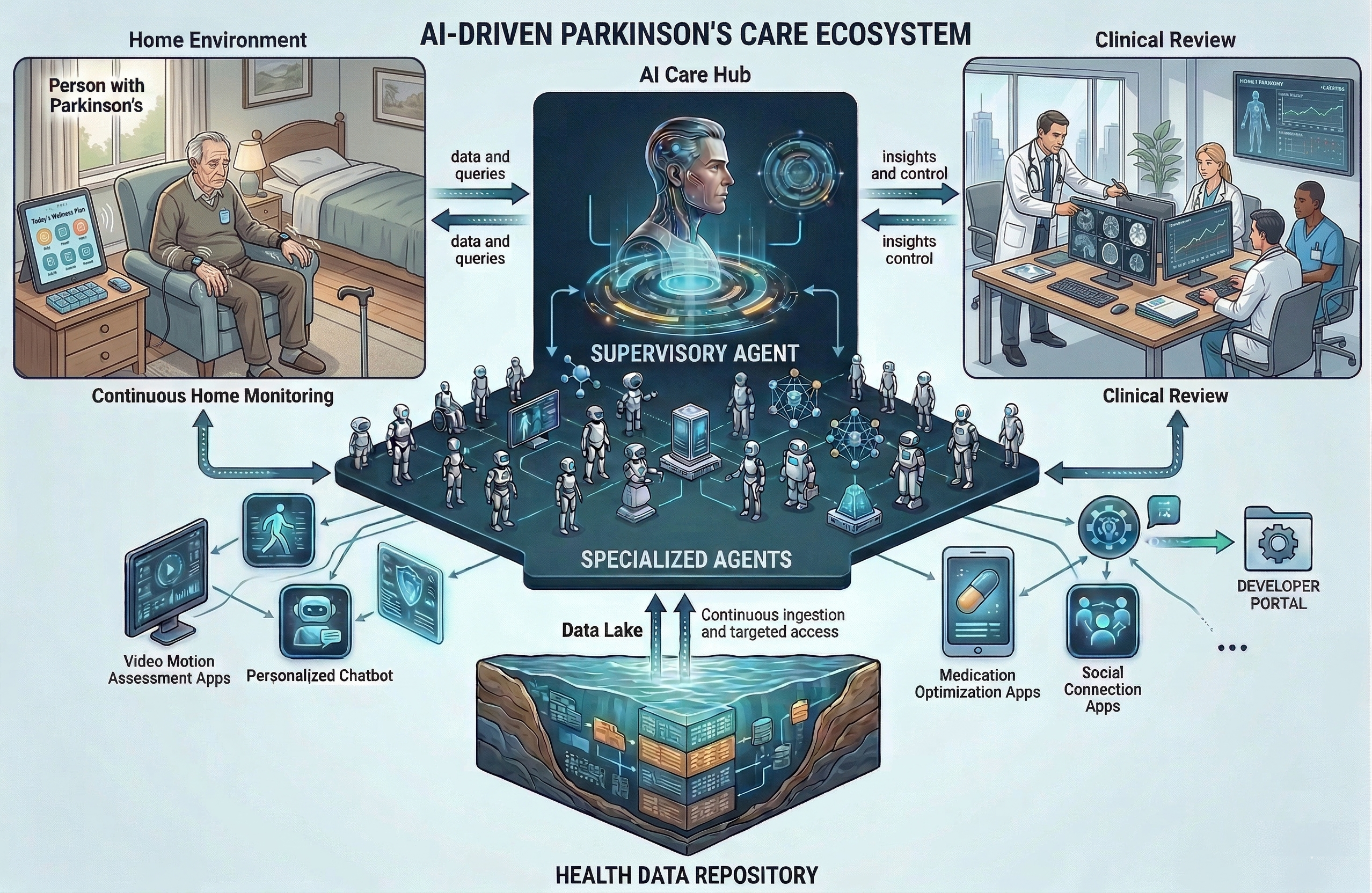
An orchestrating Ambient Care Agent coordinates three specialists: a Clinical Insight Engine for symptom analysis, a Routine Manager for medication and scheduling, and a Companion Agent for daily engagement. All operate under a 4-tier safety escalation model.

Mood Analysis Sleep Monitoring Hallucination Detection Medication Tracking
INNOVATION 02

Guideline-Encoded Reasoning

Every agent embeds validated clinical scales and threshold logic. Instead of asking "what does the data show?", the system asks "does this warrant a change in care?" Clinical decision-making is built into the AI, not layered on top.

BDI Scales MoCA Assessment Clinical Thresholds Actionable Insights
INNOVATION 03

Privacy-First, On-Device AI

All AI runs locally on the patient's device. No patient data leaves the machine. A modular SDK and app ecosystem let clinical teams extend the platform while preserving full privacy compliance.

On-Device Inference PIPEDA / BC PIPA Role-Based Access Full Audit Trail
Agent Architecture

Specialized Agents, Unified Care

Rather than one monolithic model, PIKA uses purpose-built agents that collaborate through shared memory, each focused on a specific aspect of patient care.
Ambient Care Agent (Orchestrator)
🧠

Clinical Insight Engine

Symptom-domain analyzers that evaluate patient data against encoded clinical guidelines

  • Mood & Depression (BDI)
  • Sleep Disturbance
  • Dizziness & Falls
  • Hallucinations

Autonomous Routine Manager

Adaptive scheduling and autonomous care workflow management

  • Medication Reminders
  • Appointment Preparation
  • Exercise Prompts
  • Portal Navigation
💚

Companion Agent

Daily engagement and psychosocial support to combat isolation

  • Daily Check-ins
  • Social Connection Nudges
  • Positive Reinforcement
  • Wellbeing Tracking
4-Tier Safety Escalation
1. Log
2. Nudge
3. Caregiver Alert
4. Emergency Flow
Product Preview

See PIKA in Action

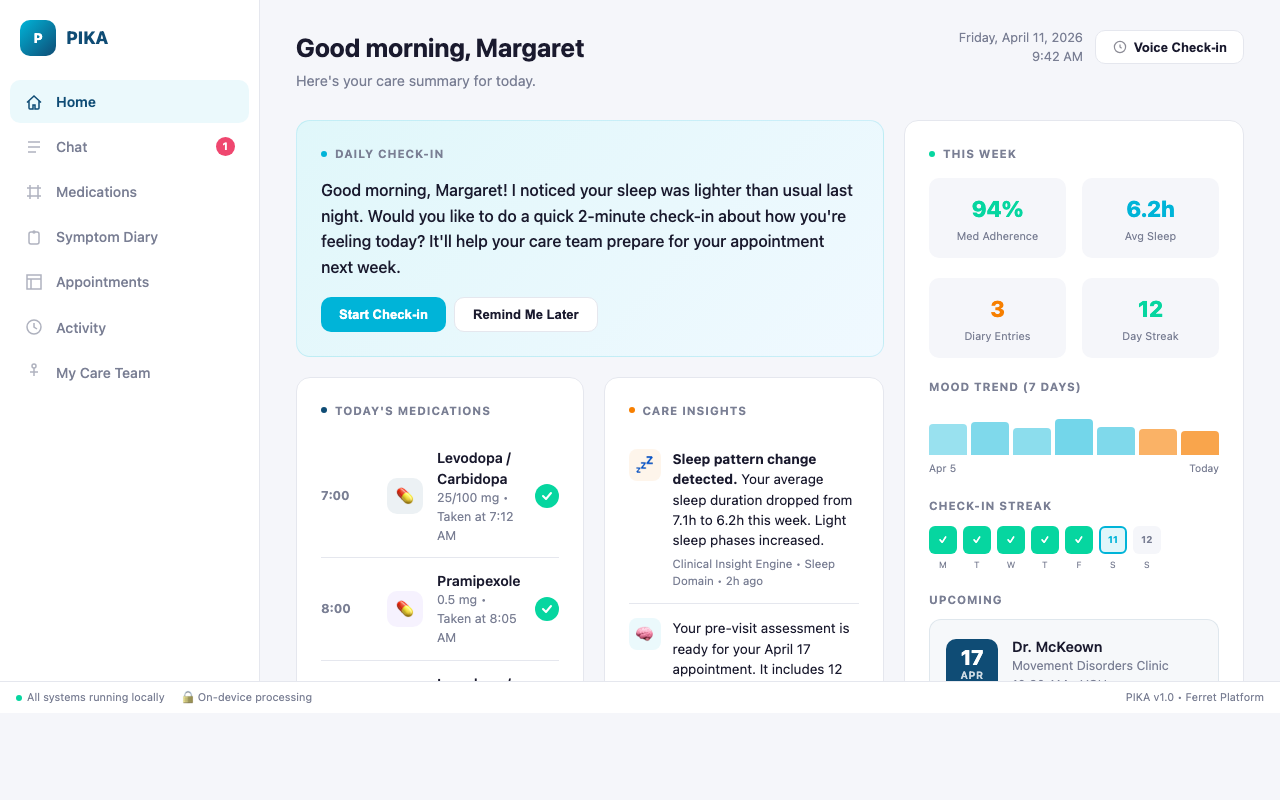
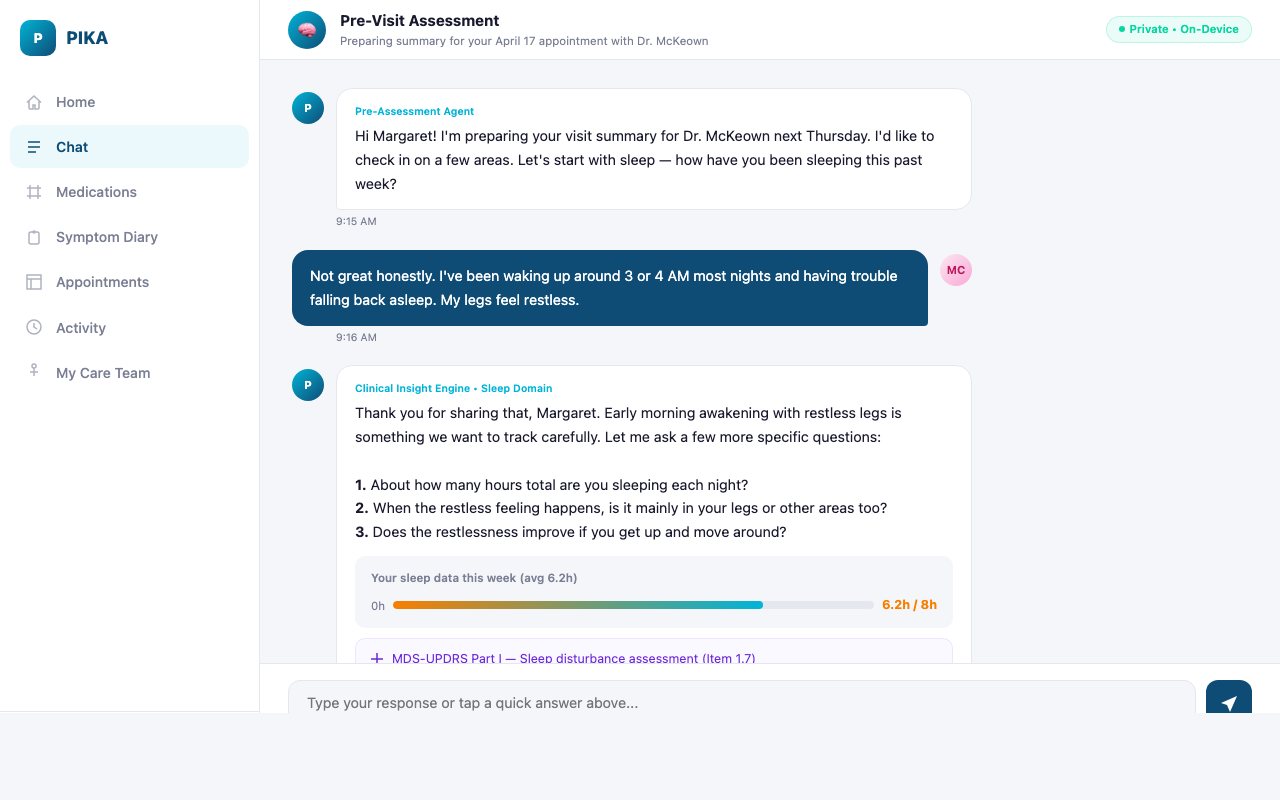
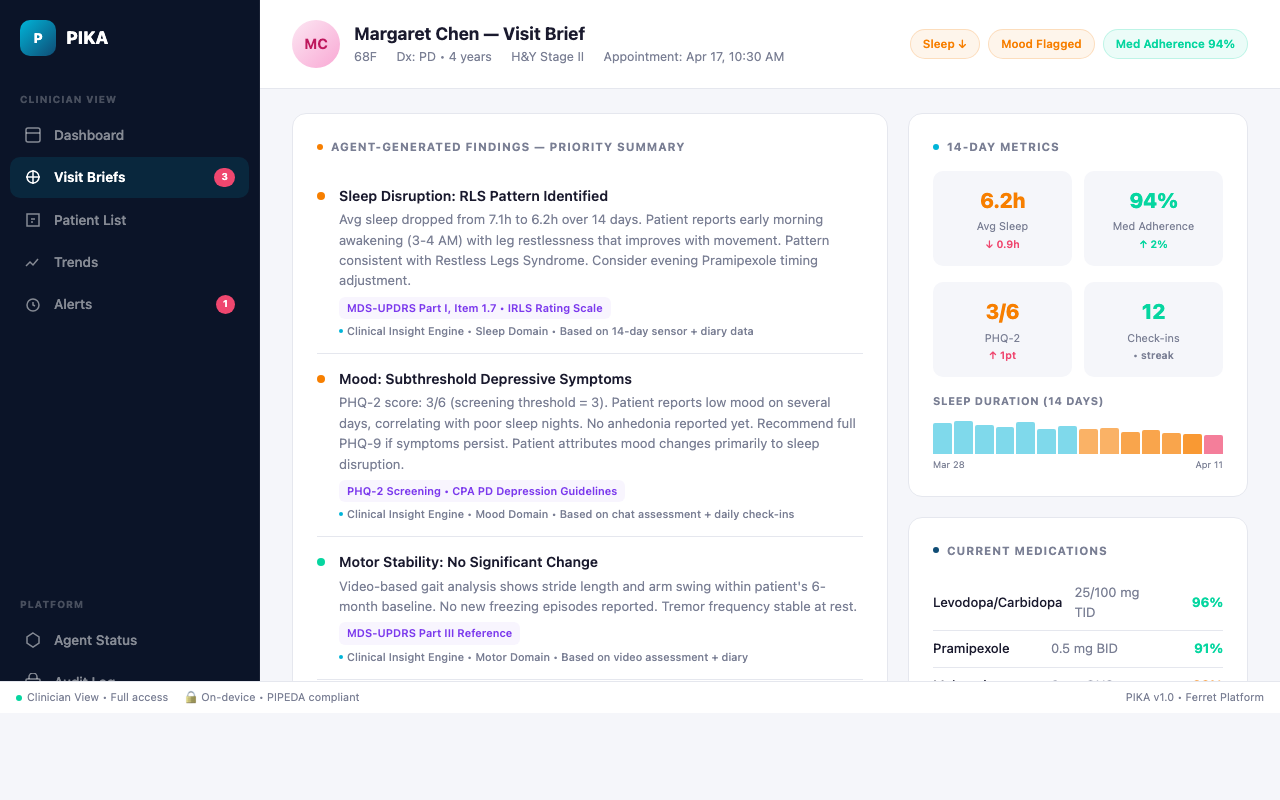
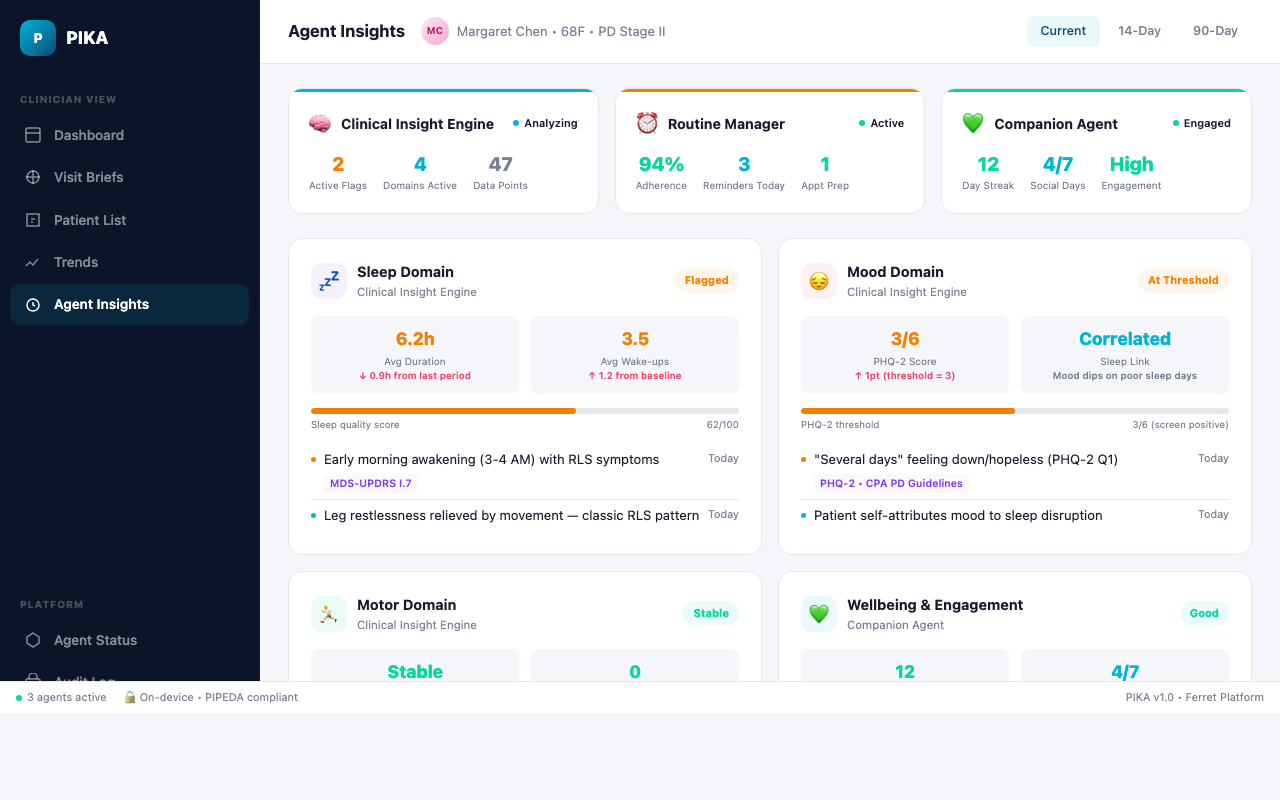
The interface adapts to each role: patients get a care companion, clinicians get visit-ready briefs, and developers get full visibility into the AI engine layer.

PIKA | Patient Dashboard
Patient home dashboard Clinical pre-assessment chat Clinician visit brief Agent insights dashboard AI engine dashboard
Patient Home: Daily care summary with companion check-in, medication tracking, mood trends, and insights from each AI agent.

Live Interaction Demo

A daily check-in session where the Companion Agent hands off to the Clinical Insight Engine for sleep and mood screening, with real-time agent routing visible throughout.

PIKA | Daily Check-in Demo
The Ferret Platform

Built on a Full AI Operating Layer

PIKA runs on Ferret, a local-first AI platform that handles multi-model inference, context assembly, memory, and application sandboxing so clinical teams can focus on care logic, not infrastructure.

System Architecture

Edge-native, privacy-preserving, clinically extensible

Stakeholders
🧑‍⚕️ Clinicians
🧓 Patients
👪 Caregivers
👨‍💻 Developers
Conversational Interface (Chat + Voice)
Clinical Apps
Pre-Assessment Chatbot
Symptom Diary
Questionnaires
Motor Assessment
Platform SDK & App Sandbox
Agent Layer
Ambient Care Agent (Orchestrator)
Clinical Insight
Routine Mgr
Companion
Shared Memory & Evidence Graph
AI Runtime
LLM (Gemma 4)
Speech (sherpa-onnx)
Vision (mlx-vlm)
Generation
7 Inference Engines • On-Device Processing
Foundation
Context Planner
Memory (Neuroscience-Inspired)
Policy & Safety Gate
Audit & Traces

🧠 Multi-Model Inference

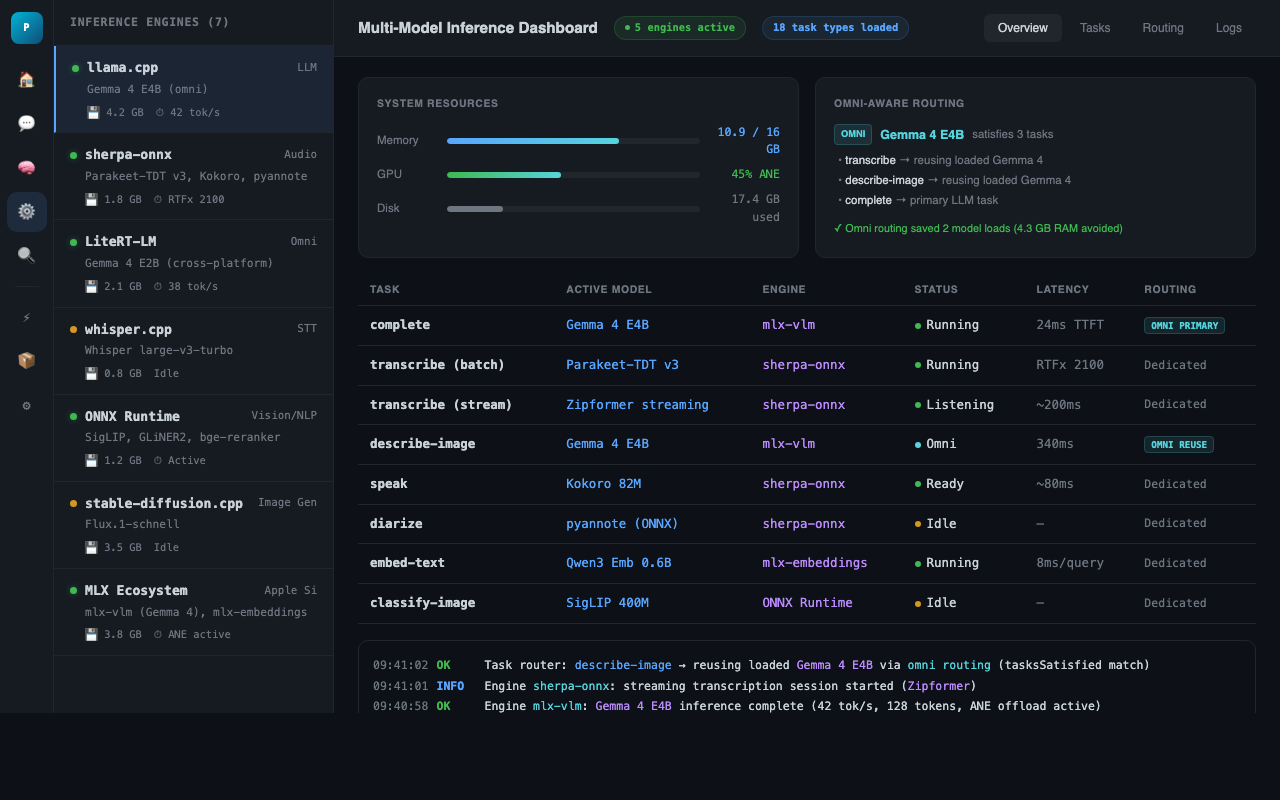
Seven inference engines (llama.cpp, sherpa-onnx, whisper.cpp, ONNX Runtime, stable-diffusion.cpp, LiteRT-LM, MLX) handle speech, vision, generation, and classification through a single task API.

📚 Neuroscience-Inspired Memory

Memories decay, reconsolidate, and surface based on relevance, modeled after how human memory actually works: spacing effects, event segmentation, surprise-gated encoding, and spreading activation.

🔧 Full Platform SDK

TypeScript and Python APIs for building apps, skills, agents, and workflows. Third-party apps run sandboxed with per-app permissions and hot-reload during development.

🛡 Safety & Compliance

Policy-gated actions, role-based access, consent management, and full trace logging for every AI decision. Designed for PIPEDA, BC PIPA, and SaMD compliance.

Clinical Validation

From Lab to Clinic to Multi-Site Trials

PIKA is already in clinical use. Here's where we are and where we're headed.

January 2024
Project Establishment
Project launched at UBC's Pacific Parkinson's Research Centre, bringing together clinical neurology and edge AI engineering.
2024 – 2025
Platform Development & Clinical Design
Ferret platform built across 5 major development phases. Clinical agent architecture designed and ethics board protocols prepared.
Complete
2025 – Present
Clinical Chatbot Deployment
Clinical pre-assessment chatbot deployed for real patient use at Vancouver Coastal Health's Movement Disorders Clinic, one of Canada's leading Parkinson's centres.
Live
2026
Full Platform Usability Study
REB-approved usability study with up to 50 PD patients, evaluating the full ambient care platform with patients, caregivers, and clinicians.
In Preparation
2026 – 2029
Multi-Site Prospective Study
Proposal submitted for a 36-month implementation study across multiple Canadian sites via the Canadian Open Parkinson Network.
Grant Submitted
2027+
Scale Across Canada & Internationally
Expansion across BC, nationally, and internationally. Language-adaptable architecture with planned Mandarin and Cantonese support for Greater China deployment.
Planned
Global Impact

Why This Matters

0
Million people living
with PD worldwide
2x
Projected increase
by 2040
0
Million PD patients
in China alone
1%
Global population
over 60 affected

Beyond Parkinson's

PIKA's architecture is modular by complication, not by disease. The same agent framework can extend to Alzheimer's, multiple sclerosis, and other chronic neurological conditions with new guideline profiles rather than new infrastructure.

Because all inference runs locally, PIKA sidesteps the biggest barrier to healthcare AI adoption: data privacy. The system is designed to meet PIPEDA, GDPR, and Chinese data protection regulations without architectural changes.

For Every Stakeholder

Patients interact through natural conversation instead of complex forms. Daily companionship combats social isolation. Medication reminders and exercise prompts provide value every single day.

Caregivers receive timely, structured updates instead of anxious guesswork. Clinicians get prioritized, guideline-referenced briefs that make each visit more focused and productive.

The Team

Neurology Meets AI Engineering

Clinical neurology, machine learning research, and industry deployment, working together at the University of British Columbia.

Dr. Martin McKeown

Dr. Martin J. McKeown

Principal Investigator
Professor & Head, Division of Neurology, UBC. John L. Nichol Chair in Parkinson's Research. Honorary Visiting Professor, Lee Kong Chian School of Medicine, Singapore. Associate Member, Department of Elec & Comp Eng. Member, Scientific Advisory Board, Parkinson Canada.
Prof. Z. Jane Wang

Prof. Z. Jane Wang

Co-Investigator
IEEE Fellow. Professor, UBC ECE. Expert in signal processing, machine learning, and biomedical data analysis.
Michael Ng

Michael Ng

PhD Researcher, UBC ECE
9 US patents in privacy-preserving computer vision. 1st place, OpenCV AI Competition 2021. ICLR 2026 publication.
Achievements

Proven Track Record

🏆

1st Place, OpenCV AI Competition 2021

On-device AI platform awarded top position by OpenCV and Intel for privacy-preserving edge architecture.

📜

US Patents

AI technology portfolio foundational to PIKA's on-device AI approach.

📄

ICLR 2026: Once-More

Perplexity-Guided Self-Correction for LLMs. Peer-reviewed at a top-tier AI venue.

📄

AI Governance Publications

Work on ethical AI governance in PD digital health, published in AJOB Empirical Bioethics (2023) and AI & Society (2024).

🏥

Clinical Deployment at VCH

Pre-assessment chatbot used by real PD patients at the VCH Movement Disorders Clinic.

Parkinson's Foundation Centre of Excellence

Pacific Parkinson's Research Centre holds this designation, recognizing world-class PD research and care.

Institutional Partners
University of British Columbia UBC Electrical & Computer Engineering Pacific Parkinson's Research Institute Vancouver Coastal Health

Continuous, Intelligent
Parkinson's Care

Moving beyond episodic clinic visits to always-on, guideline-aware monitoring and support.

Visit Research Centre Back to Top